
Email Spam Testing & Deliverability Check: - How to Really Know If You’re Hitting Inbox
Key Takeaways
- Email spam testing is not a magic score. A good result from an e mail spam checker doesn’t guarantee real inbox placement with your audience.
- Most tools only see part of the picture. A mail deliverability tester might check content, DNS, or spam lists but not your true sender reputation.
- You should always test from your real sending domain. “Sample sends” from a random domain or tool address tell you almost nothing about live campaigns.
- The best tests use multiple inboxes and mailbox providers. Gmail, Outlook, Yahoo, corporate inboxes - they all behave differently.
- The real work starts after testing. You need a clear order of operations: authentication → reputation → infrastructure → content.
- Email deliverability is a system, not a one-time fix. Regular email spam testing, monitoring and tuning is how you protect revenue long term.
- When deliverability is core to your business, a specialist pays for itself. A proper email deliverability checker process can recover opens, replies, and sales that are currently invisible.
Email is still one of the highest-ROI channels in your business.
But only if people actually see your emails.
So you sign up for an email spam checker, paste in your content, hit “Test,” and… you get 9/10. Green. Looks great.
Then you send the campaign to your list.
Your open rate is 7%. Replies are dead. Sales are flat.
If email spam testing says you’re fine, why does it still feel like you’re shouting into the void?
Because those tools are only showing you about 10% of the deliverability picture.
This guide will show you what email spam testing tools really do, how to use them properly, and what else you must check if you actually care about staying out of spam and promotions.
By the end, you’ll know:
- How to read spam test results like a pro
- How to run a proper mail deliverability tester workflow
- What to fix first when your email deliverability tester screams “problem”
- When it’s time to bring in someone who lives in this world all day
PART 1: What Email Spam Testing Tools Actually Do (And Don’t)
Before you can use any email deliverability checker, you need to know what it’s actually measuring.
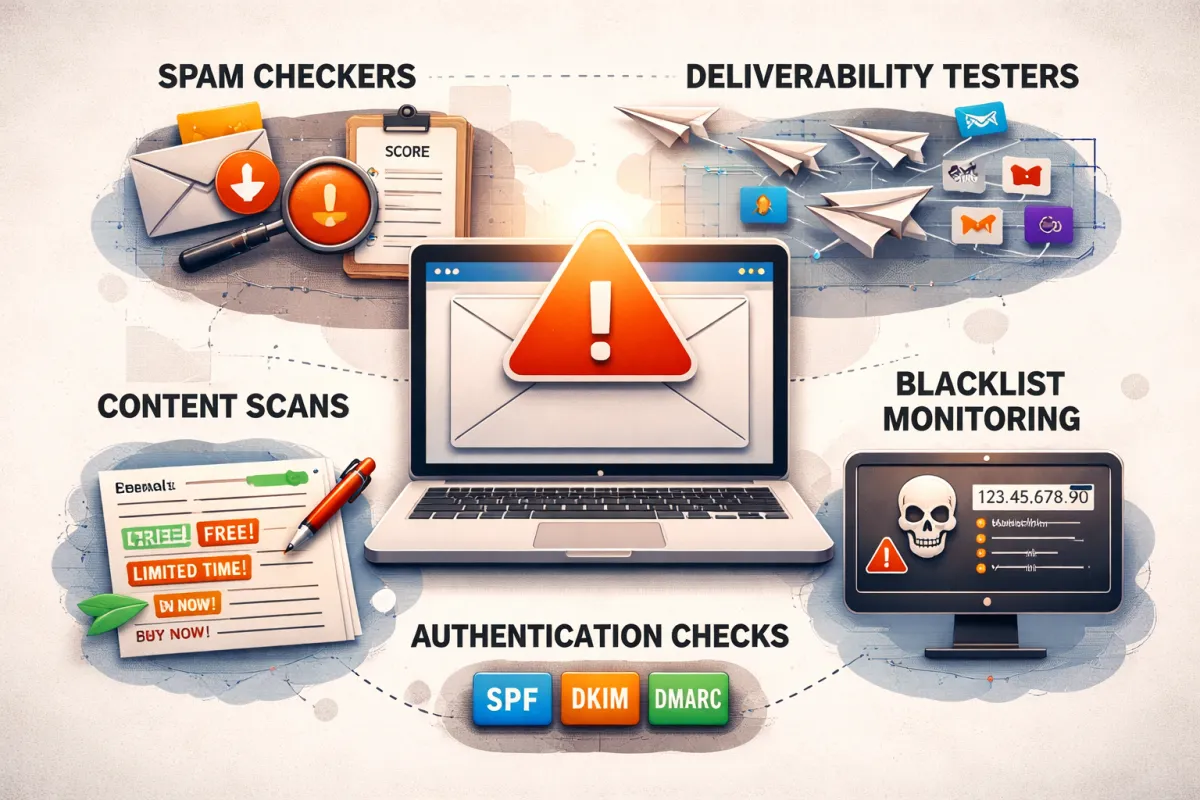
Most “email spam testing” tools focus on three main areas:
1. Content & formatting checks
They look at:
- “Spammy” phrases and keywords
- Image-to-text ratio
- Link count and link reputation
- HTML structure and broken tags
Useful? Yes.
Complete picture? Not even close.
You can write the cleanest email in the world and still go to spam if your domain is burned or your list is garbage.
2. Technical & authentication checks
A more advanced mail deliverability tester will also check:
- SPF records
- DKIM signatures
- DMARC policy
- Whether your sending IP or domain is on common blacklists
This is a big step up—because without proper authentication, inbox providers simply don’t trust you.
But even this is not the full story.
3. Seed inbox placement tests
Some tools send your email to a “seed list” of test inboxes:
- A mix of Gmail, Outlook, Yahoo, corporate addresses
- Spread across different locations and configurations
They show you a view like:
- 60% Inbox
- 30% Promotions
- 10% Spam
This is much closer to reality but remember:
Seed lists aren’t your actual subscribers.
Real engagement from your audience is still king.
What spam testers don’t see
Even the best email deliverability tester has blind spots:
- How your real subscribers engage (opens, clicks, replies, complaints)
- How often you send and how consistent you are
- Whether you bought that list three years ago and never really cleaned it
- How many people silently ignore your messages every week
- Tools are important. But they are thermometers, not doctors.
They tell you something’s off.
They don’t fix the underlying health problem.
PART 2: How to Properly Use an Email Spam Checker
If you treat email spam testing like a checkbox, you’ll get checkbox-level results.
Here’s how to use an e mail spam checker like a pro.
Step 1: Test from the actual domain you send from
Don’t run tests from:
- A personal Gmail account
- A random testing domain
- The default domain your ESP gives you
You want your test to reflect:
- Your real sending domain
- Your real from-name and from-address
- Your real sending IP / provider, where possible
If your campaigns send from [email protected], that’s what you test.
Step 2: Send the exact campaign you plan to use
Avoid testing with “similar” content.
- Test the real subject line
- Test the real body
- Test the real links and CTAs
- Test with your real tracking settings (UTMs, click tracking, etc.)
Even small changes can tip an email from inbox → spam, especially if you’re on the edge.
Step 3: Test across multiple inbox providers
At minimum, you should be checking:
- Gmail
- Outlook / Office 365
- Yahoo
- A few corporate / custom domain inboxes
Good mail deliverability tester tools do this with seed lists. If your tool doesn’t, create your own mini seed list:
- A few Gmail addresses
- A few Outlook addresses
- A few custom domains your team owns
Send your test to all of them and check where the email lands.
Step 4: Look beyond the “score”
Most tools give you a number (e.g. 8.7/10) or a color (green/yellow/red).
That’s not the interesting part.
The gold is in the detail pages:
- Do you have SPF, DKIM and DMARC configured correctly?
- Are you flagged or at risk on any blacklists?
- Are images loaded over HTTPS?
- Are there broken links or weird URLs?
- Is your sending IP known for spam?
Your job isn’t to chase a perfect score.
Your job is to identify patterns that will hurt deliverability at scale.
PART 3: The “Hidden” Deliverability Tests You Actually Need
Here’s the part most email spam testing articles skip:
Even a perfect test result can’t save you if the rest of your deliverability system is broken.
Think of tools as your dashboard, not your engine.
1. Sender reputation
Inbox providers build a long-term memory of your behavior:
- Do people open your emails?
- Do they reply?
- Do they delete without reading?
- Do they mark you as spam?
- Do your emails bounce often?
This reputation follows your:
- Domain
- IP
- From-address
- Sometimes brand and content patterns
Once this reputation is bad, new campaigns are guilty until proven innocent.
2. Domain age & warmth
New sending domains are like new bank accounts:
- High limits? Not yet.
- Blind trust? No chance.
If you:
- Register a fresh domain on Monday
- Push 5,000 cold emails on Wednesday
…you’re asking for trouble.
Proper domain warm-up means:
- Slow, consistent sending
- Positive engagement early (opens, clicks, replies)
- Gradual volume increases over weeks, not days
Spam testers don’t fully simulate this. They only give you a quick snapshot.
3. Authentication: SPF, DKIM, DMARC
This is your passport.
- SPF tells inboxes which servers are allowed to send email for your domain
- DKIM cryptographically signs your messages
- DMARC tells inboxes how to treat messages that fail checks
If any of these are missing or misconfigured:
- You look like a phisher
- Your domain is easy to spoof
- Your emails are more likely to go to spam—even if your content is good
A real email deliverability checker workflow includes verifying all three.
4. Sending patterns & volume
Inbox providers look at:
- How often you send
- How many recipients you hit at once
- Whether your volume suddenly spikes
- Whether you keep hammering unengaged contacts
Red flags:
- Long periods of silence followed by massive blasts
- Big spikes from the same domain/IP to similar audiences
- Repeated sends to people who never engage
These patterns are a big part of why “we were fine, then everything went to spam overnight.”
Your spam tester won’t fix that.
Your sending strategy will.
PART 4: When Email Spam Testing Shows Problems – What to Fix First
So you’ve run a few tests.
The email deliverability tester is throwing warnings.
Some seed inboxes show “Spam” or “Promotions.”
Where do you start?
Here’s a simple order of operations.
1. Fix authentication (SPF, DKIM, DMARC)
This is non-negotiable.
- SPF should include all your legitimate sending services
- DKIM should be active for every platform you send from
- DMARC should be configured, even if you start with a relaxed policy
Without this, everything else is built on sand.
2. Clean your list & segment ruthlessly
List quality is one of the biggest drivers of reputation.
Start with:
- Removing hard bounces
- Removing known bad or risky addresses
- Suppressing chronically unengaged contacts
Segment:
- Highly engaged (opened/clicked in last 30–90 days)
- Warm (older engagement, no negatives)
- Cold (no engagement in a long time)
Don’t treat them the same.
Hitting your cold segment with aggressive volume is a great way to tank your reputation.
3. Fix your sending patterns
Aim for:
- Consistency over hero blasts
- Predictable sending days/times
- Gradual volume changes
If you’re scaling cold email, build your volume like a staircase, not a rocket.
4. Simplify your content
If your content checks are screaming:
- Remove unnecessary links (especially to shady or unknown domains)
- Reduce heavy image usage
- Avoid big blocks of shouty, over-promotional language
- Cut “spammy” patterns like ALL CAPS subject lines and endless emojis
Content is rarely the only issue but it can be the straw that breaks the camel’s back.
5. Re-test after each change
Don’t guess.
- Run your email through your e mail spam checker again
- Re-run your email deliverability checker tool
- Track real-world results: opens, clicks, replies, spam complaints
Look for trend lines, not just one-off numbers:
- Are inbox placements improving?
- Are open rates moving up?
- Are spam complaints going down?
If not, you still have deeper issues in your infrastructure or reputation.
PART 5: A Simple Email Spam Testing Routine You Can Actually Maintain
You don’t need a dedicated deliverability engineer to get most of the benefit.
You just need a simple, repeatable routine.
Here’s a practical baseline.
Before each major campaign
- Run your main email through 1–2 email spam testing tools
- Check SPF/DKIM/DMARC health
- Test across at least 3–4 inbox providers
- Confirm links and tracking are working and clean
Weekly
- Check open rate trends by segment
- Check spam complaint rate and bounce rate
- Remove hard bounces and bad addresses
- Pause or throttle campaigns with unusually low engagement
Monthly
Audit your:
- List hygiene
- Domain and IP reputation
Sending patterns
Tool configuration (new IPs, new sending sources, etc.)
Run a more thorough email deliverability tester / seed list test
Document what you changed and how metrics responded
Deliverability is one of those things where small, consistent care beats big, occasional panics.
PART 6: When a Tool Isn’t Enough (And How We Help)
At some point, you hit a wall:
- You’ve run every email spam test under the sun
- You’ve cleaned your lists
- You’ve simplified your templates
- You’ve read 10 guides like this one
…and your numbers are still not where they should be.
That’s usually when clients come to us.
For many B2B, SaaS and ecommerce companies, email isn’t just “a channel.” It’s:
- The backbone of outbound
- The engine behind lifecycle and retention
- A big line item in the revenue report
In other words:
Deliverability issues are revenue issues.
Here’s what a professional deliverability engagement typically looks like with us:
- A full email deliverability audit of your domains, IPs, tools and campaigns
- Deep mail deliverability tester analysis across providers and regions
- Fixes for SPF, DKIM, DMARC, domain strategy and warm-up
- Sending pattern redesign and list segmentation to rebuild reputation
- Ongoing monitoring and email spam testing, so issues are caught early
If you’d rather not live inside spam test dashboards and DNS records all day, that’s exactly what we do for clients—so they can focus on writing offers and closing deals.
Ready to See What’s Really Going On With Your Email Deliverability?
If your email revenue feels capped or your cold campaigns keep dying in spam, it’s time to stop guessing.
We can run a structured email deliverability audit, show you exactly where the leaks are, and give you a clear plan to regain inbox placement—whether you want to implement it yourself or have us handle it end-to-end.

If This Has Been Bothering You for Months, One Conversation Is Overdue.
You don’t need another experiment. You need a clear yes-or-no on whether deliverability is the thing undercutting your effort—and what fixing it actually takes.
FAQs
1. How often should I run email spam testing?
For active senders, run basic spam tests before major campaigns and at least once a week on your core templates. Do a deeper deliverability check (including seed inbox testing) once a month or whenever you see a sudden drop in opens or replies.
2. Is one e mail spam checker enough?
No single tool sees everything. It’s better to use one main email deliverability checker you know well, plus occasional cross-checks with a second tool and real-world tests across multiple inbox providers.
3. If my spam score is good, why are emails still going to spam?
Because content is only part of the equation. Poor sender reputation, bad list quality, missing authentication, or aggressive sending patterns can all push mail to spam - even with a “great” test score.
4. Do I need separate domains for cold email and marketing campaigns?
In most cases, yes. Using different but related domains (and properly warming them) helps protect your main brand domain and segment risk. A deliverability audit can define the right domain strategy for your situation.
5. Can I fix deliverability myself or do I need an expert?
You can absolutely fix basic issues yourself using guides like this one. But if you’re sending at scale, relying on email for a big chunk of revenue, or running serious outbound, working with a deliverability specialist is often faster - and much cheaper than months of lost revenue.
© High Performing Emails, The Grow Revenue Company Inc. 2026 All Rights Reserved.